

Picture a damp patch on a wall.
You notice it in spring. It looks untidy, so you repaint it. The wall looks fine for a few weeks. Then the stain returns, a little larger than before.
So you buy better paint and prepare the surface properly. The patch comes back anyway.
At some point you stop blaming the paint. The water is coming from somewhere else. It could be a pipe behind the plaster.
It is something you cannot see from where you are standing.
If the same problems keep coming back in your business, you may be standing in front of a wall like this.
When the same problems keep coming back
A report arrives late, so you remind the team. It arrives on time for two months and then it slips again.
A client waits too long for a reply. You apologise and ask everyone to be quicker.
They are quicker for a while. Then it happens again with a different client.
Nobody is careless in a story like this. The team is working hard and so are you. Still, the same problems keep returning.
Each fix feels like progress, and each return feels like a small failure. After enough rounds, a leader starts to wonder whether the team is the problem.
Some leaders even begin to wonder whether the problem is them.
A better question to ask

This is the question I would ask instead.
When a problem keeps returning, what is really producing it?
That question moves your eyes from the person to the place. It asks what has to be true for this problem to happen again and again, with different people in the room.
What sits behind a recurring problem
Most recurring problems in business are not mistakes. They are the results of how work moves.
A late report is the result of how information reaches the person writing it. A forgotten reply is the result of where the request landed and who was expected to notice. The real cause is rarely a person.
Something is arranging how work moves in your business. Nobody designed it on purpose. It grew as the business grew.
A spreadsheet appeared in one place and a habit formed in another. One person simply knew how it all fitted together.
Together, these form a system that nobody can see, because nobody ever drew it.
That is why effort alone does not hold. Asking people to try harder is like repainting the wall.
It works while attention is close. When attention moves on, the system does what it has always done.
Three questions to ask the next time a problem returns
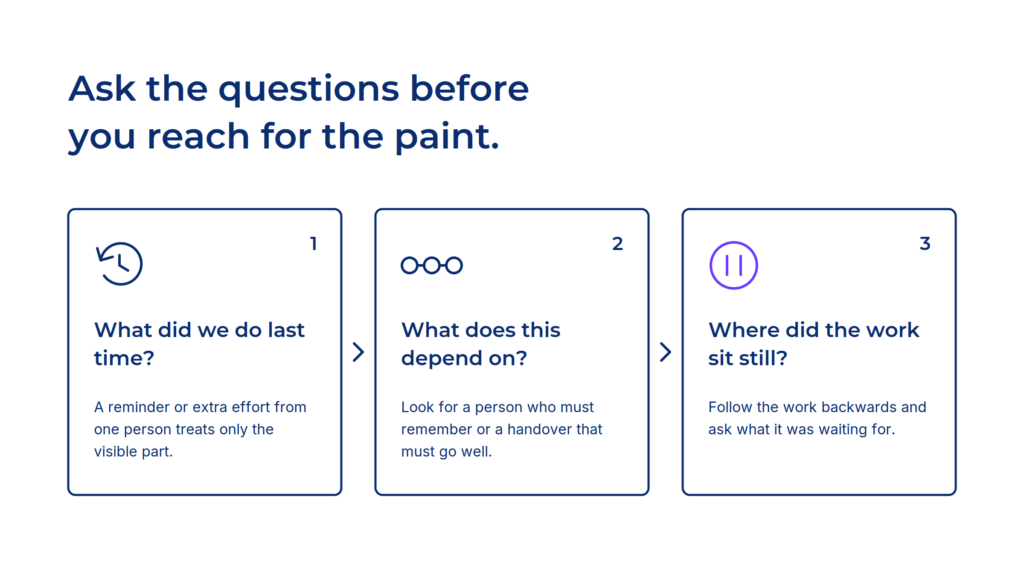
Ask these three questions with the people involved.
First, what did we do last time? If the answer was a reminder, an apology or extra effort from one person, you treated the visible part.
Second, what does this depend on? Look for a person who must remember, a message that must be seen or a handover that must go well.
Where success depends on someone remembering, the problem is waiting to return.
Third, where did the work sit still? Follow the late report backwards until you find the moment it waited. Then ask what it was waiting for.
You do not need special software for this. A notepad and an honest conversation will show you more than you expect.
What changes when you see the system
A recurring problem looks different once you can see what is producing it. It stops being a verdict on your team. It becomes a clue about how work moves.
That shift gives a leader three things.
First, you stop spending energy on the wrong target. Reminders and extra effort can ease off, because you now know where to look.
Second, your team stops carrying blame that was never theirs. People do better work when the system around them is clear.
Third, a problem gets a real chance of staying fixed. You change the place where it starts, so you are no longer repainting the same wall.
Look at who passes what to whom, where information is typed twice and where a decision waits until someone is free. You can begin with these three questions above.
What becomes possible
Picture the same business once the pipe has been found and mended. The leader is no longer hurrying around with a bucket. They have room to lead.
A thought to keep
The patch on the wall was never the real problem. It was telling you something. The problem that keeps returning in your business may be doing the same.
It is worth asking what it is trying to show you.
If you would like to see where work may be quietly waiting in your own business, the Royalty Systems Clarity Audit is a gentle place to begin.