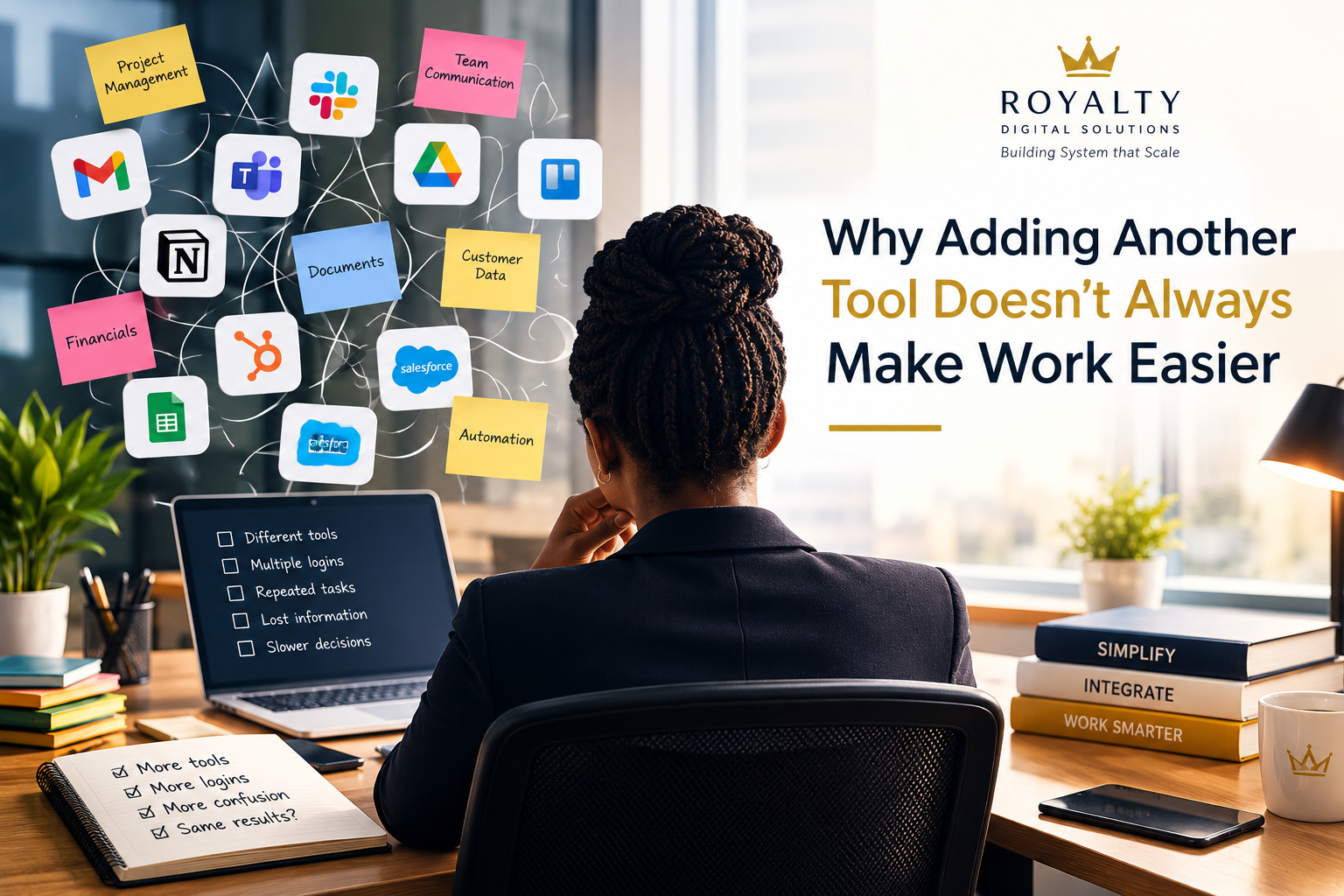
Has your organisation reached a point where there seems to be a tool for almost everything?
You may have systems for managing customer information, communication, projects, finance, documents, and perhaps another one introduced recently to connect everything. Each tool made sense when it was introduced. The problem is that work does not always stay inside one tool.
A customer request may begin in an email, move into a project management platform, require information from a spreadsheet, wait for approval in another system and eventually end with someone sending an update through a messaging platform.
The technology is not necessarily failing. But the experience of getting work done may still be more complicated than it needs to be. At some point, you may find yourself asking a difficult question.
If we have invested in all these tools, why does work still feel so difficult?
The answer may not be that you need another tool. It may be that you need to understand how all the work fits together.
Every tool solves something
Most technology decisions begin with a reasonable problem.
A team needs somewhere to manage projects, so a project management system is introduced. Communication becomes difficult, so a collaboration platform is added. Customer information becomes harder to manage, so a CRM is implemented.
A repetitive task starts consuming too much time, so someone introduces automation.
None of these decisions is necessarily wrong. In fact, each one may solve the problem it was introduced to address. The difficulty begins when those individual solutions become part of a much larger workflow.
The project management system may know that a task has been completed. But the finance team may still need someone to send an email before they know they can raise an invoice.
The CRM may contain the customer’s information, while another team keeps a separate spreadsheet because they need information that does not exist in the CRM.
The communication platform may make conversations easier, but important decisions can still become buried inside messages that are difficult for someone else to find later.
- Each system works.
- The workflow does not.
- That distinction is easy to miss.
More tools can create more places to look

One of the hidden costs of technology is not always the price of the software. Sometimes, it is the attention required to manage where information lives.
When people need to check several systems before they can complete a task, the organisation begins to rely on memory.
People learn where particular information is usually found. They remember which spreadsheet is current. They know who to ask when something does not appear in the system. They develop their own shortcuts for moving information from one place to another.
This can work surprisingly well for a while.
Then someone leaves.
A new person joins the team.
The organisation grows, and the process changes.
Suddenly, the knowledge that held the workflow together is no longer as accessible as it once was. What looked like a technology problem may actually have been a dependency on informal knowledge.
The question worth asking before adding another tool
When a team says, “We need a system for this,” it is worth pausing before deciding which system to buy.
- What is actually making this difficult today?
- Is information difficult to find?
- Is responsibility unclear?
- Are people entering the same information more than once?
- Are decisions taking too long?
- Are different teams working from different versions of the same information?
- Is someone manually moving information between systems?
- Or is the real problem that nobody has a clear picture of the entire workflow?
These questions can change the conversation.
Instead of starting with a technology requirement, you start with an operational requirement. That gives you a much better chance of choosing technology that supports the way the organisation actually needs to work.
Sometimes the best solution is removing something
There is an understandable tendency to think that improvement means adding something.
- A new platform.
- Another integration.
- A better dashboard.
- More automation.
- More features.
But sometimes the most valuable improvement comes from removing a step, a handover or even a system. Perhaps two teams do not need separate approval stages.
Perhaps information does not need to be entered twice. A spreadsheet can be retired because the main system now provides what the team actually needs. An existing platform can handle a requirement that was previously being solved with another tool.
These changes may not sound particularly impressive.
There is no exciting product announcement when you remove an unnecessary step. But for the people doing the work every day, removing unnecessary complexity can make a significant difference.
Better systems do not always mean more systems. Sometimes they mean fewer things standing between people and the work that matters.
Technology should follow the workflow

This does not mean organisations should avoid technology. Far from it, the right technology can make work significantly clearer and more reliable.
It can connect information that previously existed in separate places. It can reduce repetitive tasks. It can give leaders better visibility. It can help teams respond faster without asking people to carry more administrative work.
But technology works best when there is a clear understanding of what it is supporting. Before deciding what should be automated, it helps to understand the process being automated.
Before connecting two systems, it helps to understand what information genuinely needs to move between them.
Before replacing an existing platform, it helps to understand whether the problem lies with the platform or with the way the organisation has configured and used it.
More importantly, before introducing another tool, it is worth asking whether the organisation actually needs another system at all.
The goal is not to have fewer tools
There is no prize for having the smallest technology stack.
Some organisations genuinely need several platforms because their work is complex and their requirements are different. The goal is not to reduce technology for the sake of reducing technology.
The goal is to make the overall system of work easier to understand and manage. That means people should know where work begins, where it goes next, what information is required, who is responsible and what should happen when something changes.
Technology should help make that possible. It should not force people to become experts in working around unnecessary complexity. When the workflow is clear, technology has a much better chance of becoming an enabler rather than another layer to manage.
Before you add, understand
If your organisation is considering another tool, perhaps the most useful question is not
“Which platform should we choose?”
It should be
“What do we need to change about the way this work happens?”
- The answer may lead you to a new platform.
- It may lead you to an integration.
- It may lead you to automation.
- It may even lead you to removing something that has been part of the process for years.
Whatever the answer is, it should begin with understanding.
We believe technology should serve the way an organisation needs to work, rather than forcing the organisation to work around its technology. Adding another tool can make one problem disappear while creating another somewhere else.
The better question is not how much technology your organisation has. It is whether your technology helps your organisation work better.
Luqman Segun Eyitayo is an automation & backend systems consultant who helps leaders understand intelligent & complex systems to make smarter decisions for organisational capability and sustainable growth. His work spans brand strategy, web content, copywriting and B2B marketing. He is a LinkedIn Top Voice in Copywriting, Web Content and B2B Marketing Strategy. He helps you bring a strategic, audience-centred approach to every piece of your work.
If you find this post insightful, you can subscribe to our newsletter for more updates.