
Perhaps you have noticed that the technology your organisation introduced to make work easier has gradually become another thing your people have to manage.
The systems are there. Your team knows how to use them. You have invested in software to help people communicate, manage information and keep everyday work moving. Yet somehow, simple work still seems to take more effort than it should.
Someone is searching through an email thread for information that should already be easy to find. A team member is updating a spreadsheet because the system does not quite give another team what it needs. A decision is waiting because the person who needs to act on it cannot see what has happened earlier in the process.
None of these things may seem serious on their own. But when they happen every day, they begin to change the way your organisation works. People spend more time coordinating. Teams develop their own ways of getting around the systems they have been given.
Gradually, the technology that was supposed to make work easier becomes another layer of work to manage.
At that point, it is natural to think you need a better system. But what if the system is not actually the problem?
When technology becomes the obvious answer
Technology is often the easiest place to look when something in the organisation is not working as well as it should. There is always another platform that promises to improve collaboration or automate repetitive work.
Sometimes a new system is the right answer. But there is an important question worth asking first.
What exactly are you trying to fix?
If a request passes through five people before reaching the person who can make a decision, a new system may help move it faster. But if those five handovers are unnecessary, you have not solved the problem. You have simply made the existing process more efficient.
The same happens when information has to be entered into several systems. Connecting them may reduce manual work, but it does not explain why the information needs to travel through all of them in the first place.
Technology can improve a workflow, but it cannot always tell you whether the workflow itself makes sense.
Perhaps the problem is the way work moves
Think about a process in your organisation that regularly requires follow up. A client request comes in and needs to be reviewed by several people before anyone can act on it. A team member has to check one system, update another and then send an email before the next person can continue.
You may have become so accustomed to working this way that it no longer feels unusual. That is often how operational friction develops.
A process works well enough when an organisation is small and everyone understands what needs to happen. Then the organisation grows. More people become involved. Systems are added to support the growth. The work still gets done, but the path it takes becomes harder to see. That is when small inconveniences become structural problems.
Look at the workflow before looking for the tool
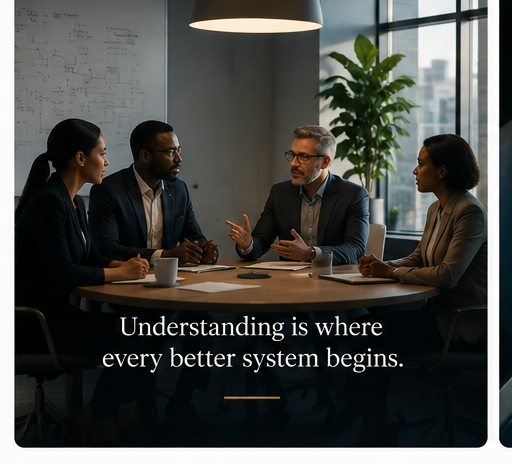
Before deciding what technology you need, it can be useful to step back and look at how the work actually moves today.
Where does the work begin? Who becomes responsible for it at each stage? Which steps require approval, and why? Where does someone have to intervene manually? Most importantly, where does the work slow down?
These questions can reveal things that are difficult to see when everyone is focused on their own part of the process. You may discover that an approval exists simply because it has always existed, or that a spreadsheet has become essential to the organisation not because it is the best solution. But because it has quietly become the bridge between systems that were never designed to work together.
None of these discoveries automatically means you need new technology. They mean you need a clearer understanding of the workflow.
Growth has a way of exposing what used to work
Sometimes, nothing has actually gone wrong. Your organisation has simply changed. The process that worked perfectly when five people were involved may become difficult to manage when twenty are involved. A founder who once approved every decision may eventually become a bottleneck without intending to become one.
New departments create new handovers. New clients create new information requirements. The organisation has grown, but the way work moves through it has not grown at the same pace. This is why adding another tool can sometimes make things more complicated.
The organisation does not need to return to the way it used to work. It needs a way of working that reflects where it is now and where it needs to go next.
The real question is not whether you need automation

Automation is extremely valuable when applied to the right problem. It can remove repetitive work and help information reach the right person at the right stage.
But before asking what should be automated, there is a more important question. Is this the right way for the work to happen?
That question changes the conversation. Instead of starting with a platform, you start with the workflow. Instead of asking which task can be automated, you examine whether the task needs to exist in its current form.
The answer may still be automation, integration or a redesigned workflow. But now the technology has a clearer purpose. It is responding to an understood organisational need, rather than becoming the starting point for solving an unclear problem.
Before you introduce another tool, understand what needs to change
If work has become difficult to manage, the answer may eventually involve new technology. But that does not mean technology should be the first conversation.
The better starting point is understanding how work currently moves, where friction has developed and what your processes need to achieve as the organisation grows. Once that becomes clear, the technology decision is much easier to evaluate.
This is why your first step is to begin with understanding before recommendation. Look at how work moves through your organisation, examine the people, processes and systems involved. Only after that you can determine whether technology, integration or automation has a role to play.
Transformation should not begin with the technology you can buy. It should begin with understanding the organisation you are trying to improve.
Sometimes the smartest technology decision an organisation can make is not choosing a new system. It is taking the time to understand the system it already has.
If you find this post insightful, subscribe to our newsletter for more insights, and updates to lead your organisation conveniently.